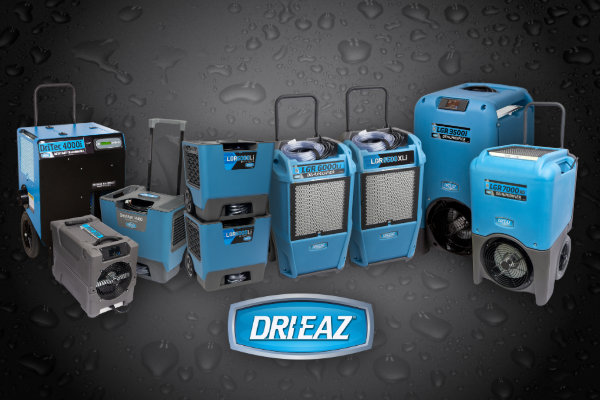
In water damage restoration, time isn't just money—it's structure. The longer moisture sits, the higher the risk of secondary damage, mold growth, and structural compromise. For restoration professionals, the key to winning against the clock lies in your equipment arsenal. Specifically, choosing the right dehumidifier for the specific class and category of water loss can make or break your drying strategy.
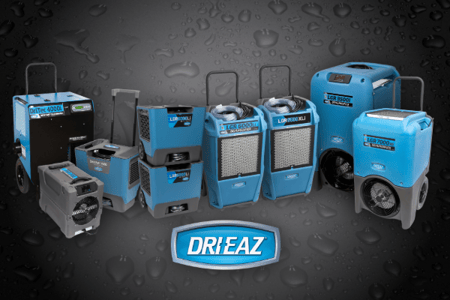
Dri-Eaz has long been a staple in the industry, known for rugged reliability and performance. However, with a wide range of models available—from compact refrigerants to high-capacity desiccants, knowing exactly which unit to deploy can be a challenge. This guide breaks down the specifications, ideal applications, and performance of the top Dri-Eaz dehumidifiers to help you maximize efficiency on every jobsite.
Understanding Technology:
Refrigerant vs. Desiccant
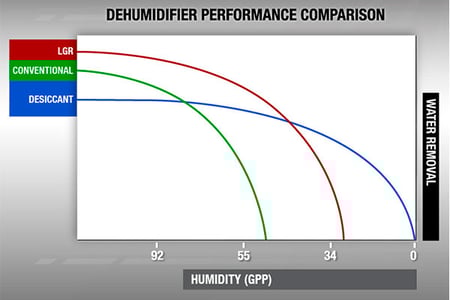
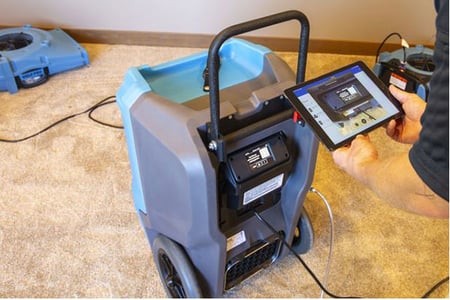
Before diving into specific models, it is crucial to understand the two main technologies at play. Most standard restoration jobs utilize refrigerant dehumidifiers (often Low Grain Refrigerants or LGRs), which cool air to condense moisture. They are the primary drying equipment used for most Class 1, 2, and many Class 3 losses under typical ambient conditions.
Desiccant dehumidifiers, on the other hand, use chemical attraction to pull moisture from the air. They perform exceptionally well in extreme heat or cooler temperatures when you need to achieve very low specific humidity (grains per pound, or GPP), making them ideal for drying dense materials like hardwoods or concrete.
The Dri-Eaz Lineup: A Technical Breakdown
To help you select the right tool for the job, we have compiled the technical specifications and best-use scenarios for the leading Dri-Eaz models.
LGR 5000Li: The Compact Workhorse
When space is at a premium, the LGR 5000Li delivers. The LGR 5000Li represents a significant step up in LGR technology. It maintains a compact footprint like the DrizAir® 1400 but utilizes Low Grain Refrigerant technology to pull more water, even as humidity levels drop. It is stackable and highly portable.
| FEATURE | SPECIFICATION |
| Water Removal (AHAM) | 80 pints / 37.9 liters per day |
| Water Removal (Saturation) | 164 pints / 77.6 liters per day |
| Amps | 5.1 A |
| Process Air | 215 CFM |
| Dimensions (H × D × W) | 19.5 × 16 × 20 in. |
| Weight | 69 lbs |
| XACTIMATE | WTRDHM>L |
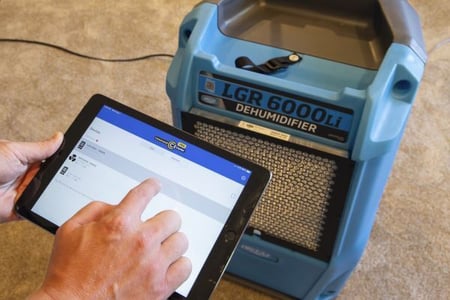
Pro Tip: Use the LGR 5000Li for standard water losses where you need the efficiency of an LGR but the portability of a small unit. The Bluetooth-enabled Command Hub allows for remote monitoring, saving you time on daily monitoring visits. Its low amp draw allows you to daisy-chain multiple airmovers on the same circuit.
LGR 6000Li: The Quiet Performer
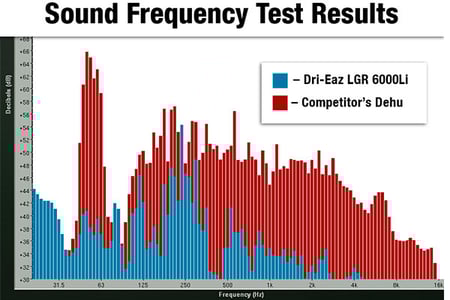
If you are working in an occupied residence or business where noise is a concern, the LGR 6000Li is your best bet. It is engineered to be the quietest in its class while delivering impressive water removal rates. This unit features Extreme Dewpoint Technology (EDT), which allows it to respond faster to changing humidity conditions--maintaining strong moisture removal as the environment dries.
| FEATURE | SPECIFICATION |
| Water Removal (AHAM) | 100 pints / 47.3 liters per day |
| Water Removal (Saturation) | 219 pints / 103.6 liters per day |
| Amps | 6.5 A |
| Process Air | 320 CFM |
| Dimensions ( H x D x W) | 32.1 x 19.8 x 20.0 in. |
| Weight | 99 lbs |
| XACTIMATE | WTRDHM>L |
Pro Tip: The 6000Li shines in customer-facing environments. Use it in occupied residential losses, offices, schools, or healthcare spaces where maintaining a quieter jobsite helps reduce disruption while still delivering professional drying performance.
LGR 6500XLi: Xactimate "Extra Large" Performance
For larger losses requiring significant drying power, the LGR 6500XLi fits the "Extra Large" category in Xactimate, ensuring you get properly compensated for the power you bring to the job. It also utilizes Extreme Dewpoint Technology (EDT) to maximize water removal efficiency as job-site conditions change and delivers XL performance while operating quietly-just like the LGR 6000Li- so you don’t have to trade sound levels for capacity.
| FEATURE | SPECIFICATIONS |
| Water Removal (AHAM) | 125 pints / 59.2 liters per day |
| Water Removal (Saturation) | 245 pints / 116 liters per day |
| Amps | 7.8 A |
| Process Air | 320 CFM |
| Dimensions (H × D × W) | 32.1 × 19.8 × 20.0 in. |
| Weight | 106 lbs |
| XACTIMATE | WTRDHM>>XL |
Pro Tip: This is a versatile unit for substantial residential floods or commercial jobs. Its rotomolded housing is nearly indestructible, making it a safe bet for rigorous daily use. Because the 6500 uses the same body, controls, and footprint as the LGR 6000, teams can simplify tech training, standardize equipment layouts, and optimize warehouse storage without changing workflows.
LGR 7000XLi: The Heavy Hitter
The LGR 7000XLi is legendary in the industry for its ability to pull water in low-grain conditions. It features advanced cross-flow technology, which maximizes air movement across the refrigeration coils to improve moisture removal efficiency and maintain a strong performance. Its larger capacity makes it ideal for severe water damage scenarios such as flooded commercial spaces, multi-room residential losses, healthcare facilities, and large structural drying projects
| FEATURE | SPECIFICATIONS |
| Water Removal (AHAM) | 130 pints / 61.5 liters per day |
| Water Removal (Saturation) | 235 pints / 111.2 liters per day |
| Amps | 8.8 A |
| Process Air | 280 CFM |
| Dimensions (H × D × W) | 33.5 × 20 × 20 in. |
| Weight | 106 lbs |
| XACTIMATE | WTRDHM>>XL |
Pro Tip: Deploy the 7000 when you need maximum grain depression to dry deep into structural materials. Despite its size, the unit was engineered with real jobsite usability in mind. A balanced frame, durable wheels, and weight distribution make the 7000XLi easier to transport and position than many units in its class.
LGR 3500i: The Commercial Giant
When you are dealing with massive commercial losses or large open spaces, the LGR 3500 is the tool of choice. It is the largest capacity portable model in the Dri-Eaz lineup, capable of controlling humidity in spaces up to 17,000 cubic feet. Designed for high air volume environments, the 3500i delivers powerful moisture removal and strong grain depression to help restoration professionals stabilize large spaces quickly. Its high-capacity performance makes it particularly effective in warehouses, gymnasiums, retail floors, schools, and manufacturing facilities
| FEATURE | SPECIFICATIONS |
| Water Removal (AHAM) | 170 |
| Water Removal (Saturation) | 270 |
| Amps | 10.8 A |
| Process Air | 400 CFM |
| Dimensions | 40.5 × 23 × 24 in |
| Weight | 157 lbs |
| XACTIMATE | WTRDHM>>>XXL |
Pro Tip: This unit falls into the XXL category in Xactimate. It’s ideal for warehouses, large retail spaces, or institutional drying where controlling humidity across a large footprint is critical to preventing secondary damage and accelerating drying progress.
Specialty Solutions: Standard Refrigerant and Desiccant
DrizAir® 1400: The Humidity Control Specialist
Not every job requires LGR technology. For standard drying tasks, humidity control in basements, or Class 1 water damage, the DrizAir 1400 is a dependable option. It removes 64 pints at AHAM and is a perfect unit for maintaining environments or handling Class 1 water. The DrizAir 1400 also represents the next evolution from the well-known DrizAir 1200, delivering improved performance in a more compact and efficient design.
| FEATURE | SPECIFICATIONS |
| Water Removal (AHAM) | 64 pints / 30 liters per day |
| Water Removal (Saturation) | 130 pints / 61.5 liters per day |
| Amps | 4.7 A |
| Process Air | 215 CFM |
| Dimensions (H × D × W) | 19.5 × 16 × 20 in. |
| Weight | 66.5 lbs |
Pro Tip: This unit is ideal for humidity control and great for navigating tight stairwells, crawlspaces, or crowded contents rooms. Professionals who relied on the 1200 will find the 1400 familiar in its reliability, but with upgrades that make it easier to transport and deploy on job sites.
PHD 200: The Crawlspace Champ
Nicknamed "The Crawlspace Champ" by many, the PHD 200 Dehumidifier shines in tight, confined areas like crawlspaces and basements. Its compact design makes it the go-to choice for those hard-to-reach spaces. With an ability to efficiently remove moisture while maintaining a low amp draw, it ensures thorough drying without overloading circuits. The nickname captures its reputation for being reliable and ideal for conquering the toughest crawlspace challenges.
| FEATURE | SPECIFICATIONS |
| Water Removal (AHAM) | 75 pints / 35.5 liters per day |
| Water Removal (Saturation) | 150 pints / 71 liters per day |
| Amps | 3.7 A |
| Process Air | 250 CFM |
| Dimensions (H × D × W) | 17 × 17 × 222 in. |
| Weight | 65 lbs |
Pro Tip: The PHD 200 Dehumidifier is an excellent choice for both small and medium-sized crawlspace or basement areas. Its compact design and durable rotomolded housing make it a go-to for residential use in tight spaces.
DriTec® 4000i: The Desiccant Solution
When ambient temperatures fall outside the optimal operating range for LGR refrigerant dehumidifiers, drying performance can be limited. In these challenging conditions — or when drying dense materials like hardwood, plaster, or complex assemblies — the DriTec 4000i desiccant dehumidifier provides a reliable solution. It generates extremely dry, low-vapor-pressure air to aggressively pull bound moisture from materials and maintain drying progress
| FEATURE | SPECIFICATIONS |
| Water Removal | 118 pints per day (80°F/60% RH) |
| Process Air | 395 CFM |
| Reactivation Air | 65 CFM |
| Amps | 12 A (requires two circuits) |
| Dimensions (W × H × D) | 21.14 × 33.13 × 20.25 in. |
| Weight | 95 lbs |
| XACTIMATE | WTR DHMD |
Pro Tip: Unlike refrigerants, the DriTec 4000 performs consistently regardless of temperature. Use it in unheated spaces during winter or for specialty drying situations where achieving very low GPP is critical.
Best Practices for Equipment Selection
Selecting the right dehumidifier goes beyond just grabbing what is on the truck. Follow these steps to ensure optimal drying and billing accuracy:
Calculate Requirements: Always perform your psychrometric calculations to determine the pint capacity required for the affected cubic footage and class of water loss. Check out the Free Dri-Eaz Psychrometric calculator available on Apple and Google Play.
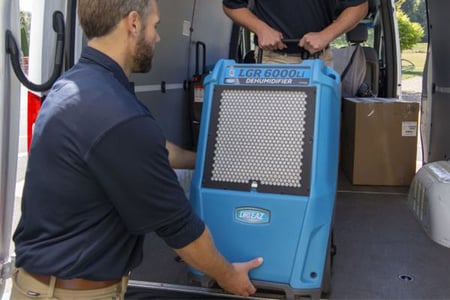
Consider Access: Don't send an LGR 3500 to a job on the third floor of a walk-up apartment. Use LGR 5000Li for difficult access areas.
Check Power Availability: Ensure the jobsite has adequate amperage. High-capacity units like the DriTec 4000i require dedicated circuits.
Monitor Remote Data: Utilize the Command Hub features on the i-Series units. Being able to check grain depression and inlet/outlet conditions remotely allows you to prioritize site visits and catch equipment issues before they delay the project.
Consider Service and Warranty Support: Dri-Eaz units are designed for the realities of restoration work, with accessible parts and strong manufacturer warranty coverage. Every unit is backed by a best-in-class warranty, including lifetime housing coverage and up to six years on the compressor and coil, plus one full year of parts and labor. Reliable service support means less downtime, faster repairs when needed, and greater confidence that the equipment will perform throughout the life of the job and for years of projects to come.
Elevate Your Restoration Standards
In the restoration business, efficiency translates directly to profitability and reputation. By understanding the specific capabilities of equipment, you can deploy the right assets to the right job, ensuring faster drying times and happier customers. Whether it is the compact power of the LGR 5000Li or the sheer volume of the LGR 3500i, Dri-Eaz offers a solution for every scale of water loss – from environmental control to catastrophic losses – Dri-Eaz delivers performance you can count on.
Equip your team with the knowledge to use these tools effectively, and you will see the difference in your drying curves and your bottom line.
If you’d like to deepen your knowledge of advanced drying solutions, including proper equipment selection, psychrometric calculations, and the Institute of Inspection Cleaning and Restoration Certification (IICRC) standards for equipment and procedure, we invite you to continue your education with us.
Visit the class schedule on the Restoration Sciences Academy (RSA) website to explore upcoming courses. We offer in-person, hands-on training in Nashville, TN, and Burlington, WA, where you’ll gain practical experience working directly with industry-standard drying equipment and real-world scenarios.
%20(1).png?width=450&name=Rogue_Blog_Post_Image%20(600%20x%20400%20px)%20(1).png)
.png?width=450&name=twojobs%20(2).png)
.png?width=450&name=Untitled%20(34).png)











.jpg?width=450&name=email_387159171-(2).jpg)



.jpg?width=450&name=werner_microscrope-(2).jpg)
.jpg?width=450&name=custcommentcard_210417437-(2).jpg)

.jpg?width=450&name=winespill-(2).jpg)
.jpg?width=450&name=uptool_stairs2-(2).jpg)
.jpg?width=450&name=inkexit_extract1-(2).jpg)



.jpg?width=450&name=reminder_postcard_postimage-blog-(2).jpg)





.jpg?width=450&name=cigarette-smoke_1222816192-(2).jpg)
.png?width=450&name=LB.Com%20Blog%20Image%20Template-1%20(1).png)